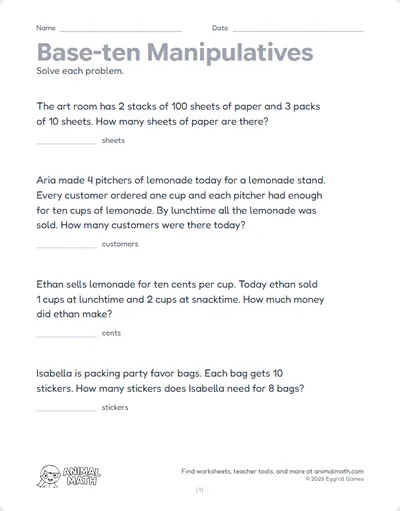
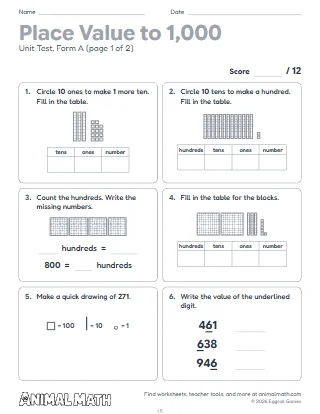
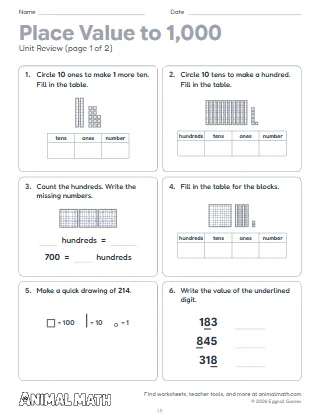
Five pages, one for each first lesson of three-digit place value. Page 1 shows 10 to 19 rods: students circle ten of them to make a hundred, then write the hundreds, tens, ones and the number (13 tens 2 ones is 132). Page 2 counts hundred flats (4 flats are 4 hundreds, 400, and 4 hundreds 0 tens 0 ones), then hundreds facts such as 700 = 7 hundreds and 10 tens = 100, and a count by hundreds to 900. Page 3 reads base-ten blocks into a place value table, then asks for two numbers as quick drawings: a square for a hundred, a stick for a ten, a circle for a one. Page 4 puts the same digit in the hundreds, the tens and the ones place (352, 527, 815): circle its place and write what it is worth. Page 5 is about zero: circle the number the blocks show (407, not 47 or 470), then write numbers with a place left out, such as 6 hundreds 3 ones. Each page starts with a worked example.
Before page 1, have students line up ten rods on a flat to see that they cover it. Before page 5, build 47 and 407 side by side and ask what the 0 in 407 tells you: there are no tens, but the 4 still has to be in the hundreds place.
Use dollars, dimes and pennies: 3 dollars, 0 dimes and 5 pennies is $3.05, the same as 305 cents. Ask how many dimes make a dollar (ten tens make a hundred).
This pack supports the following Common Core State Standards for Mathematics:
© Copyright 2010. National Governors Association Center for Best Practices and Council of Chief State School Officers. All rights reserved.
Place value for three-digit numbers, from ten tens making a hundred to zero holding a place. Students count hundred flats, read base-ten blocks into a place value table, make quick drawings and find the value of each digit.
Tell us what to make next, or build your own with a worksheet maker.
This worksheet is free to download, print, copy, and hand out in your classroom or at home. You do not need to create an account, and there are no watermarks on the PDF.