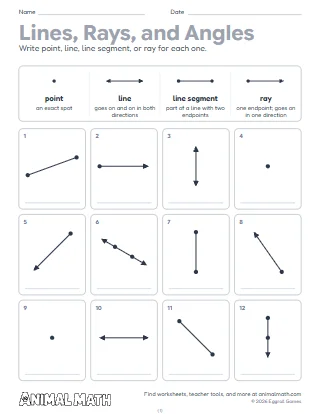
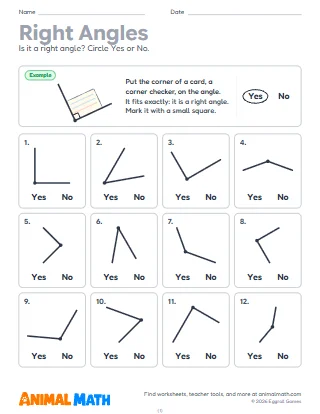
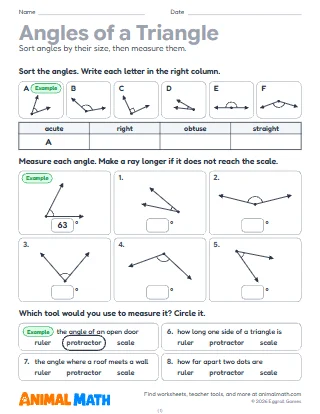
Five pages on sorting flat shapes by their sides and angles. Page 1 names pairs of lines and segments as parallel, perpendicular, or intersecting, writes ∥ or ⊥ between named lines in a figure, and names the sides and angles of a quadrilateral with letters. Page 2 names seven triangles by their angles (acute, right, obtuse) and by their sides (equilateral, isosceles, scalene), reading the tick marks and right angle squares, then asks which pairs, such as right and isosceles, a triangle can be. Page 3 explains the marks (tick marks for equal sides, arrows for parallel sides, a square for a right angle), gives the best name for eight quadrilaterals, and checks every name that fits in a table. Page 4 fills in the quadrilateral family tree from quadrilateral to square and decides if statements such as "A rectangle is a square" are always, sometimes, or never true. Page 5 sorts eight quadrilaterals in a Venn diagram (4 right angles, 4 equal sides) and lists the shapes that have a given property.
Before page 1, have students hold two pencils parallel, then perpendicular, then crossing at a slant. Before page 3, draw a rectangle and a square on the board and mark them together: each pair of equal sides gets its own number of ticks, each pair of parallel sides its own number of arrows. On page 4, ask why a square sits under both the rectangle and the rhombus: it has everything each of them has.
Go on a shape hunt: windows, books, tiles, and street signs. For each one, ask your child to point out a pair of parallel sides and a right angle, and to give its best name. Then ask for another name that also fits, such as a door that is a rectangle and also a parallelogram.
This pack supports the following Common Core State Standards for Mathematics:
© Copyright 2010. National Governors Association Center for Best Practices and Council of Chief State School Officers. All rights reserved.
Sorting triangles and quadrilaterals by sides and angles. Students name lines and angles with ∥, ⊥ and ∠, classify triangles by angles and sides, name quadrilaterals from their marks and sort shapes in a Venn diagram.
Tell us what to make next, or build your own with a worksheet maker.
This worksheet is free to download, print, copy, and hand out in your classroom or at home. You do not need to create an account, and there are no watermarks on the PDF.