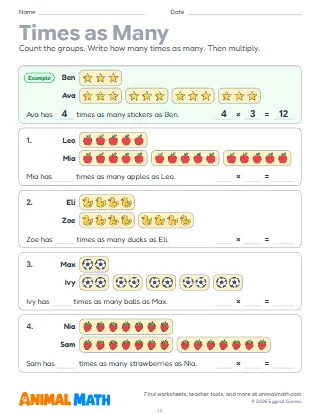
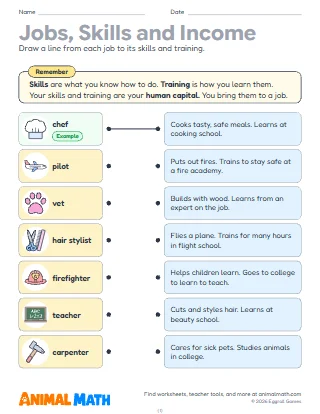
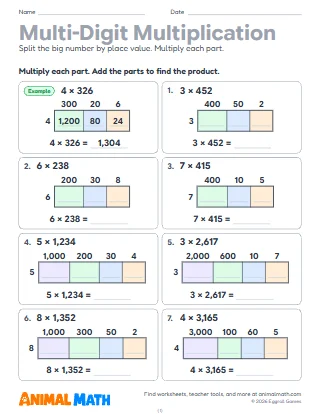
Five pages that build up to multiplying a 2-digit number by a 1-digit number. Page 1 shows equal groups of base-ten blocks, such as 3 groups of 24: students count the tens and the ones, then put them together, trading 10 ones for a ten when there are 10 or more. Page 2 has six area models: the 2-digit number is split into tens and ones across the top, students write the two partial products inside and add them. Page 3 writes the same partial products in a column, with a reminder beside each row, such as 40 × 3. Page 4 has twelve problems with numbers up to 99 and room to work, solved with blocks, an area model or partial products. Page 5 has six word problems, like 4 buses with 38 children each.
Start page 1 with real base-ten blocks: build 3 groups of 24, push the tens together and the ones together, and trade 10 ones for a ten. On page 2, connect the two parts of the rectangle to the two lines on page 3: the big part is the tens times the number, the small part is the ones. Let students compare strategies on page 4 with a partner.
Ask your child to break the big number into tens and ones out loud: 6 × 37 is 6 × 30 and 6 × 7, so 180 and 42, which make 222. Use dimes and pennies to act out a problem from page 1.
This pack supports the following Common Core State Standards for Mathematics:
© Copyright 2010. National Governors Association Center for Best Practices and Council of Chief State School Officers. All rights reserved.
Multiplying a 2-digit number by a 1-digit number with place value strategies, for products up to 1,000. Students count base-ten blocks in equal groups, use area models and partial products, and solve word problems.
Tell us what to make next, or build your own with a worksheet maker.
This worksheet is free to download, print, copy, and hand out in your classroom or at home. You do not need to create an account, and there are no watermarks on the PDF.