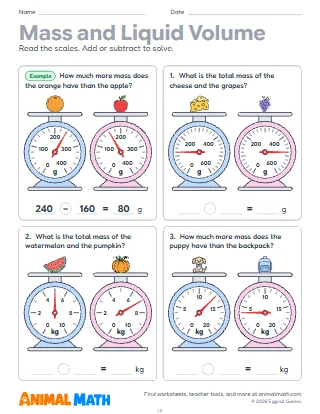
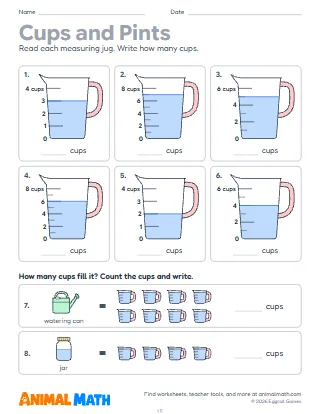
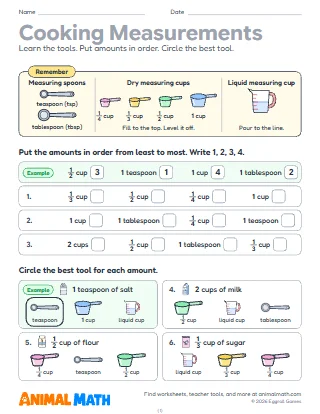
Five pages about measuring liquid volume. On page 1 students read eight graduated cylinders, each numbered every 100 mL but with tick marks every 50, 20 or 10 mL, so they first work out what one tick is worth. Page 2 has drink cups marked to 250 mL and measuring jugs marked in milliliters and in liters; students write each amount with its unit. On page 3 the containers are empty, and students color the water up to the amount shown. Page 4 asks whether milliliters or liters is the better unit for ten everyday things and for the best estimate of four more. Page 5 has six one-step word problems: pouring together, filling up, equal glasses and sharing.
Before page 1, fill a clear cup or a measuring jug with water and read it together: find the numbers, then count the ticks between two numbers to see how much each tick is worth. Page 3 works well with blue crayons or colored pencils. For page 4, pass around a teaspoon, a water bottle and a bucket and talk about which ones hold less than a liter.
Look at a measuring jug, a water bottle or a juice carton together and find the milliliters or liters printed on it. Fill a measuring cup to 250 mL and pour it into a glass, then ask how many glasses would fill a 1 liter bottle.
This pack supports the following Common Core State Standards for Mathematics:
© Copyright 2010. National Governors Association Center for Best Practices and Council of Chief State School Officers. All rights reserved.
Liquid volume in milliliters and liters, read on graduated cylinders, drink cups and measuring jugs. Students read scales, color water up to an amount, choose the better unit and best estimate, and solve one-step word problems.
Tell us what to make next, or build your own with a worksheet maker.
This worksheet is free to download, print, copy, and hand out in your classroom or at home. You do not need to create an account, and there are no watermarks on the PDF.