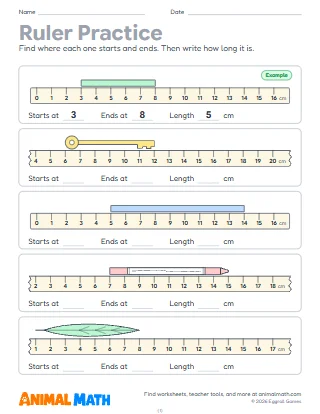
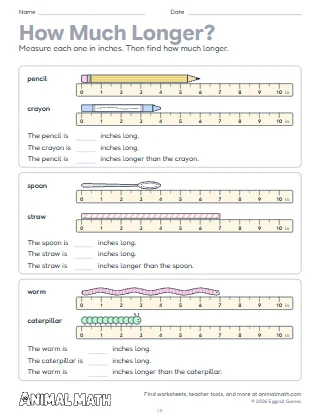
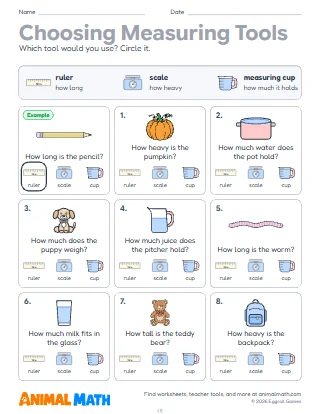
Five pages on units and tools. On page 1 each thing is drawn twice at real size, once on an inch ruler and once on a centimeter ruler: students write about how many inches and about how many centimeters (the first is worked as an example). Page 2 gives a length in one unit and asks which length in the other unit makes sense (a 4 inch crayon is about 10 centimeters, not 2), then asks why the centimeter number is always bigger. On page 3 each pair is measured in different units, and students circle the thing that is really longer; in two pairs the bigger number belongs to the shorter thing. Page 4 shows a ruler, a yardstick and a tape measure, and students circle the best tool for eight jobs, from a crayon to the way around a watermelon. Page 5 does the same with a centimeter ruler and a meter stick, and adds circling centimeters or meters.
Give each pair of students a ruler with inches on one edge and centimeters on the other. Measure the same pencil with both edges and write the two numbers on the board: why is one bigger? Lay ten centimeter cubes beside four inch tiles to see the size of each unit. Before page 4, pass around a ruler, a yardstick and a tape measure, and try measuring around a ball with each one.
Find a ruler or tape measure with inches and centimeters. Measure a spoon, a shoe and a book both ways and make a little table. Then ask: what tool would you use to measure the couch, the way around your head, or a toothbrush?
This pack supports the following Common Core State Standards for Mathematics:
© Copyright 2010. National Governors Association Center for Best Practices and Council of Chief State School Officers. All rights reserved.
Measuring one thing in inches and in centimeters, and picking the right tool. Students measure on real-size rulers, compare lengths across units, and pick a ruler, yardstick, tape measure or meter stick for each job.
Tell us what to make next, or build your own with a worksheet maker.
This worksheet is free to download, print, copy, and hand out in your classroom or at home. You do not need to create an account, and there are no watermarks on the PDF.