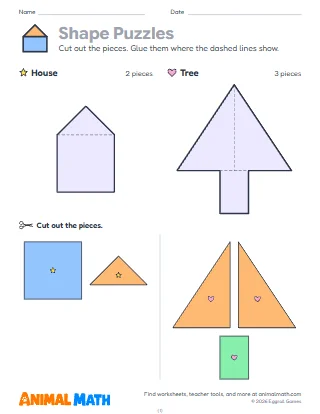
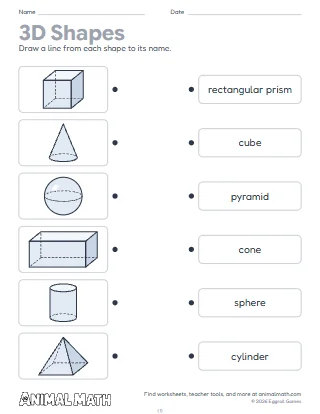
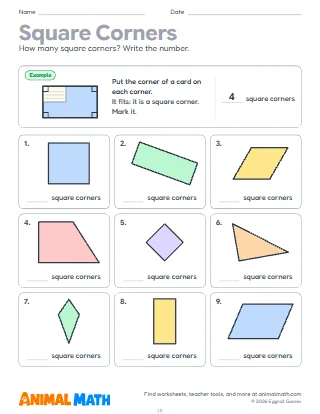
Five pages about what makes a flat shape the shape it is. Page 1 starts with a worked triangle: students count the sides and the corners of a rectangle, a circle, a hexagon, a square and a trapezoid, then write each name from the word bank. A circle has 0 sides and 0 corners. On page 2 students circle every triangle in a field of twelve shapes, then every rectangle in a field of ten. The real ones are big and small, turned and long and thin; the look-alikes have a gap, a curved side, a rounded corner, four sides or a slant. Page 3 shows six pairs of shapes and asks whether both are squares, triangles, hexagons, trapezoids, rectangles or circles, then four true or false sentences about turning, size, curved sides and gaps. Page 4 gives clues such as 3 sides and 3 corners, or 4 square corners with 2 long sides and 2 short ones; students draw each shape on dot paper and write its name. Page 5 puts shapes together: circle the two shapes that make a square, a rectangle, a circle and a hexagon, find how many triangles make a hexagon, and count the triangles, squares, rectangles and half-circles in a robot.
Before page 1, pass around paper shapes and have students trace each side with a finger and tap each corner as they count. For page 2, hold up a paper triangle, turn it upside down and ask whether it is still a triangle; then cut a slit in one side and ask again. Pattern blocks make page 5 hands-on: let students build the square, the rectangle and the hexagon from two pieces before they circle, and fill a hexagon with green triangles.
Go on a shape hunt: a door is a rectangle, a clock is a circle, a slice of sandwich cut corner to corner is two triangles. Ask how many sides and corners each one has. Cut a paper square in half two different ways and see which two shapes you get.
This pack supports the following Common Core State Standards for Mathematics:
© Copyright 2010. National Governors Association Center for Best Practices and Council of Chief State School Officers. All rights reserved.
What makes a flat shape the shape it is: its sides and corners. Students count sides and corners, find real triangles and rectangles among look-alikes, draw shapes from clues on dot paper and put shapes together.
Tell us what to make next, or build your own with a worksheet maker.
This worksheet is free to download, print, copy, and hand out in your classroom or at home. You do not need to create an account, and there are no watermarks on the PDF.