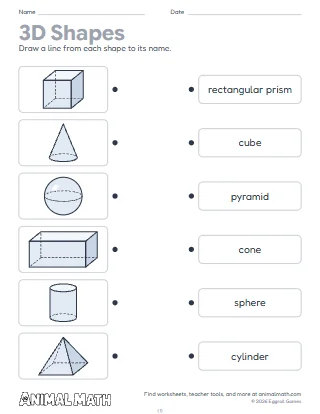
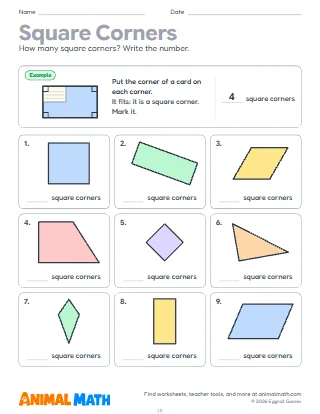
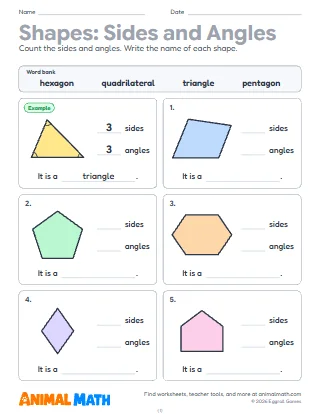
Five pages on solid shapes. Page 1 names six 3D shapes from drawings, the cube worked first, and four everyday things that look like them, with a word bank. Page 2 starts with a labeled cube (face, edge, vertex), then students count the faces, edges and vertices of a rectangular prism, a pyramid and a triangular prism, and sort eight lettered shapes into only flat faces and a curved surface. On page 3 students circle the shape of every flat face of a solid (a pyramid has squares and triangles) and count its flat faces. Page 4 compares two shapes, such as which has more faces or which has no vertices, then asks of six shapes whether each can roll and whether it can stack. Page 5 is six riddles, each with exactly one shape that fits.
Pass around wooden or plastic solids, or boxes, cans and balls from home. Have students put a sticker on each vertex and run a finger along each edge as they count, then stamp each face in paint to see its flat shape before page 3. Test page 4 for real: roll each shape down a ramp of books, then try stacking it.
Hunt for 3D shapes in the kitchen: a cereal box, a soup can, an orange, an ice cream cone. Count the faces of a box together and trace one on paper. Ask which things could roll off the table and which could stack in a tower.
This pack supports the following Common Core State Standards for Mathematics:
© Copyright 2010. National Governors Association Center for Best Practices and Council of Chief State School Officers. All rights reserved.
Cubes, prisms, pyramids, cylinders, cones and spheres, with their faces, edges and vertices. Students name shapes from drawings and everyday things, count faces, edges and vertices, tell which roll or stack and solve riddles.
Tell us what to make next, or build your own with a worksheet maker.
This worksheet is free to download, print, copy, and hand out in your classroom or at home. You do not need to create an account, and there are no watermarks on the PDF.